

On this date in 1868 the 14th Amendment to the U.S. Constitution was ratified (made official). It is often referred to as one of the Reconstruction Amendments because it was created as a response to the end of slavery and Civil War.
Lately several of its sections have been in the news.
Let’s start with Section 1 which covers a few things. The part that’s been in the news lately is “birthright citizenship.” But Section 1 also guarantees due process and equal protection under the law at all levels of government.
The following video gives a good overview of the history of Section 1.
In its June 27, 2025 decision on Trump v. CASA the Supreme Court sidestepped questions about birthright citizenship. Instead they focused on whether a nationwide injunction on Executive Order (EO) 14160 was an over-reach by the lower court (they said it was).
Since the decision did not address the constitutionality of birthright citizenship itself, the EO is still in place but not in effect for 30 days. During that time experts expect “the district courts to issue further orders within the next month and . . . for anyone who may be expecting a baby in the next few weeks, is that nothing changes for the next 30 days and anyone born in the United States is still a U.S. citizen.” (1)
OTHER SECTIONS OF THE 14TH AMENDMENT:
Section 2 had 2 parts. The first changed the formula used to determine how many representatives each state would have in Congress by removing the Three-Fifths Clause, which only counted enslaved people as 3/5 of a person.
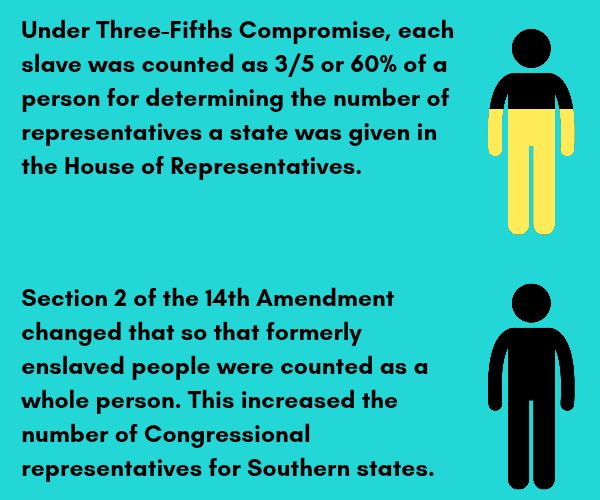
Without actual granting freedmen the right to vote, second part of Section 2 basically “threatened the South with a loss of representation should black men be denied the vote.” (2) However Southern states ignored this potential penalty and Congress never tried to enforce it.
We cannot help but wonder if enforcing this part of Section 2 would have shortened the long struggle for Black Voting Rights AND/OR prevented some of the recent laws that make voting more difficult for many Black individuals.
Section 3: (Insurrection Clause) “no person who had ever taken an oath to support the Constitution (which included all who had been in the military service or held state or national office before 1860) and then participated in the rebellion against the Union [United States] could be a senator or representative or hold any civil or military office, national or state.”
In 2024 a group of Colorado voters tried to keep Trump off the ballot, referring to the Insurrection Clause. The legal battle went to the Supreme Court which ruled that Section 5 (of the 14th Amendment) delegates enforcement of the Insurrection Clause to Congress for federal and state officers. And since Congress didn’t challenge his eligibility, he was able to run for a 2nd Presidential term.
Section 4 made it legal for Congress to take on debt, as well as refuse to compensate slave owners for their losses due to slaves being freed.
Section 5 gave Congress authority to pass legislation to enforce the provisions of the Fourteenth Amendment.
SUPREME COURT DECISIONS & THE 14TH
Trump v. CASA was not the first time the 14th Amendment was involved in a Supreme Court decision. In fact, “the amendment, particularly its first section, is one of the most litigated parts of the Constitution, forming the basis for landmark Supreme Court decisions, such as Brown v. Board of Education (1954; prohibiting racial segregation in public schools), Loving v. Virginia (1967; ending interracial marriage bans), Roe v. Wade (1973; recognizing federal right to abortion until overturned in 2022), Bush v. Gore (2000; settling 2000 presidential election), Obergefell v. Hodges (2015; extending right to marry to same-sex couples), and Students for Fair Admissions v. Harvard (2023; prohibiting affirmative action in most college admissions).” (3)
You can be sure the recent case is not the last time the Supreme Court will be asked to make a decision about Individual Rights which have been won as a result of this amendment.
FOOTNOTES
(1)
https://www.nilc.org/articles/analyzing-scotus-trump-v-casa/
(3) https://en.m.wikipedia.org/wiki/Fourteenth_Amendment_to_the_United_States_Constitution#:~:text=The%20amendment%2C%20particularly%20its%20first,marriage%20bans)%2C%20Roe%20v.
Leave a Reply