
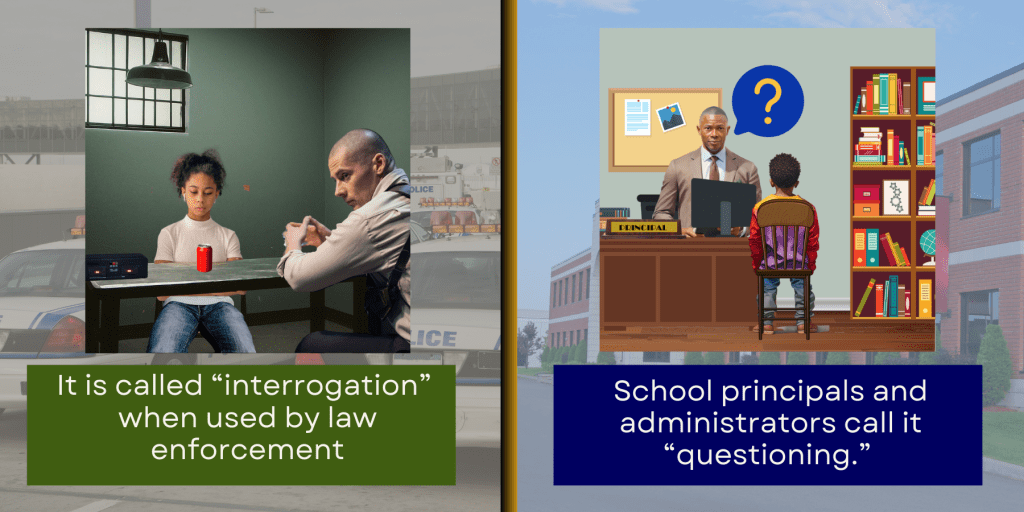
In the early 2000’s Reid & Associates began offering a one day in-person course for school principals and other administrators. The course has gone by two names: “Developing Investigative Interviewing Skills for School Administrators” and “Are You Sure They’re Telling the Truth? Developing Investigative Interviewing Skills for School Administrators”. When the COVID-19 pandemic forced the world to go virtual, Reid & Associates developed a virtual version of the course which continues to be offered multiple times a year by both Reid & Associates and various professional educator associations.
Are School Administrators Being Trained Like Police?
Reid & Associates has always claimed the School Administrators course is different from what is taught to law enforcement. However, the course overview includes the same topics and sections as the law enforcement course. Unlike Reid’s manuals for law enforcement which can be purchased from Reid’s website and booksellers such as Amazon, the materials for the 6-hour training for school administrators are only available to those who take the course.
1In 2016 New Yorker journalist, Douglas Starr, interviewed two women who had taken the training in 2015. Neither were school administrators. Jessica Schneider was a staff attorney at the Chicago Lawyers’ Committee for Civil Rights and Laura Nirider was a professor of law at Northwestern University and the project director of the Center on Wrongful Convictions of Youth. These are excerpts from that article:
Like the adult version of the Reid Technique, the school version involves three basic parts: an investigative component, in which you gather evidence; a behavioral analysis, in which you interview a suspect to determine whether he or she is lying; and a nine-step interrogation, a nonviolent but psychologically rigorous process that is designed, according to Reid’s workbook, “to obtain an admission of guilt.”
Buckley’s only caveat during the session, according to Nirider and Schneider, was that children under the age of ten should not be interrogated. “It was pretty horrifying,” Schneider told me.”
At one point in the workbook, the phrase “Handling tears” appears, with a blank space underneath for trainees to take down Buckley’s dictation. “Don’t stop,” Schneider wrote in her notes. “Tears are the beginning of a confession. Use congratulatory statement—‘Glad to see those tears, because it tells me that you’re sorry, aren’t you?’
What’s the Harm?
A student questioned by school personnel (without law enforcement) have no legal protections or Miranda rights. No right to remain silent. No right that their parent be notified, let alone be present. No right to an attorney.
And what they say to school personnel is consistently ruled admissible in court based on: (1) the common law rule of “loco parentis” meaning that principals and other school administrators operate in the best interest of the child just as the parent would and (2) the situation in which a student is questioned/interrogated by school personnel is not a custodial situation, meaning the student is free to leave at any time.

How long has this training been happening in Michigan? In a 2016 New Yorker article, “Wendy Zdeb, the executive director of one of those affiliates, the Michigan Association of Secondary School Principals, told me that her group is preparing to host its twentieth Reid seminar in the past eleven years.”
Principals need training in disciplinary and student incident investigative procedures that are both effective and age appropriate. The Reid course is neither of these.
Want to read more about Reid Training for School Principals? We’ve gathered a few articles for you below:
- https://prospect.org/power/teacher-may-plead-fifth/
- https://truthout.org/articles/why-are-k-12-school-leaders-being-trained-in-coercive-interrogation-techniques/
- https://www.newyorker.com/news/news-desk/why-are-educators-learning-how-to-interrogate-their-students
Footnotes
- “Why Are Educators Learning How to Interrogate Their Students?”, Douglas Starr, The New Yorker,
March 25, 2016 ↩︎